
A Chronicle of WGAW – Post-War Origins to Modern Broadcasting Voice
80 Years of Service to the region: 1946 to 2026
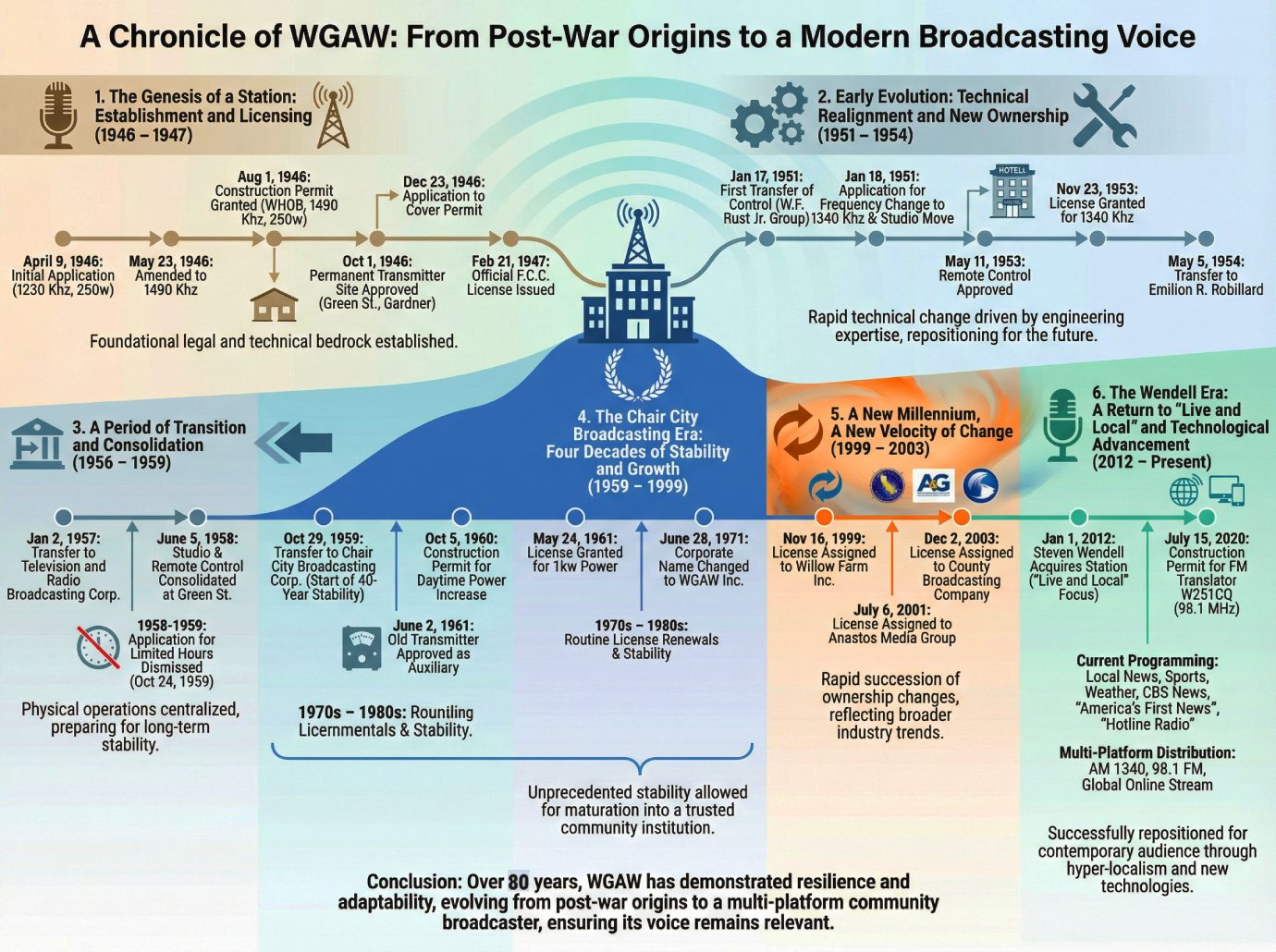
A Chronicle of WGAW: From Post-War Origins to a Modern Broadcasting Voice
Introduction
This is a chronological history of the WGAW radio station, tracing its evolution from an initial application in the post-war optimism of 1946 through its modern operations as a multi-platform community broadcaster. The station’s journey from its first call letters, WHOB, to its present-day identity is marked by key technical, ownership, and programming milestones that highlight its resilience and adaptability. In many ways, the story of this single Gardner, Massachusetts station reflects the broader evolution of the American radio industry itself—a narrative of technological advancement, shifting corporate landscapes, and an enduring commitment to local community service.
——————————————————————————–
1. The Genesis of a Station: Establishment and Licensing (1946 – 1947)
The immediate post-World War II era was a period of significant growth in American broadcasting, as technologies refined during the war were applied to civilian life. For a community like Gardner, Massachusetts, securing a new broadcast license represented a vital step in establishing a modern, local voice. The founding of the station was a deliberate and methodical process, navigating the rigorous federal regulatory environment to bring a new media outlet to the region.
The station’s foundational history unfolded through a series of precise regulatory steps:
• April 9, 1946: An initial application was filed with the Federal Communications Commission (F.C.C.) by five individuals: David M. Richman, Rose S. Richman, Owen A. Hoban, M. Alan Moore, and Rex Reynolds. The proposal was for a 250-watt station at 1230 Khz, with a proposed studio at 39 Pleasant Street.
• May 23, 1946: The application was amended, changing the proposed frequency to 1490 Khz.
• August 1, 1946: The F.C.C. officially granted the construction permit for a new station with the call letters WHOB, authorized to operate at 1490 Khz with 250 watts of power.
• October 1, 1946: The permit was modified to approve a permanent transmitter location on Green Street in Gardner, a site specified as being just 1,800 feet north of Henry Heywood Hospital. This decision proved remarkably durable, as this site has remained the station’s sole point of transmission throughout its entire history.
• December 23, 1946: An application was filed to formally cover the construction permit as modified, a significant step that occurred just before the Christmas holiday.
• February 21, 1947: The official F.C.C. license was issued, formally sanctioning the station’s operations a few months after it had already commenced broadcasting in late 1946.
These initial steps established the legal and technical bedrock upon which the station would be built. This careful progression from application to licensed operation illustrates the structured process required to enter the federally regulated broadcasting industry of the mid-20th century. With its license secured and its transmitter site established, the station was poised for its next phase of life, one that would be defined by its first major technical and ownership changes.
——————————————————————————–
2. Early Evolution: Technical Realignment and New Ownership (1951 – 1954)
In the early years of a radio station’s life, its frequency and ownership structure are critical elements that define its operational footprint and competitive position. For WHOB, the early 1950s became a period of fundamental realignment, where a new ownership group immediately initiated a strategic technical change that would shape the station’s identity for the remainder of its history.
The key events of this transformative period occurred in rapid succession:
• January 17, 1951: The first recorded transfer of control took place, as the license was voluntarily passed from the original founders to a new entity led by W.F. Rust Jr., H.S. Killgore, William J. Barkley, and Ralph Gottlieb.
• January 18, 1951: The very next day, the new ownership group filed an application to change the station’s frequency from 1490 Khz to its current position at 1340 Khz. The application also proposed relocating the main studio from 39 Pleasant Street to the Green Street transmitter site.
• May 11, 1953: A license modification was granted allowing for remote control of the transmitter from the Colonial Hotel, located at 4 Pleasant Street.
• November 23, 1953: More than two years after the initial application, the license for the frequency change to 1340 Khz was officially granted by the F.C.C.
The brief tenure of the W.F. Rust Jr. ownership group was exceptionally impactful, primarily because the change was driven by direct engineering expertise within the new ownership. W.F. Rust Jr. was not merely a new principal; he was the engineer who personally authored the application to change the station’s frequency. This fact explains the swift and deliberate nature of the technical realignment, framing it as a move to fundamentally reposition the station’s specifications for its long-term future. Having accomplished this critical objective, the group transferred control on May 5, 1954, to a new single owner, Emilion R. Robillard. This period of rapid technical and corporate change set the stage for subsequent operational adjustments and further ownership shifts.
——————————————————————————–
3. A Period of Transition and Consolidation (1956 – 1959)
After establishing its core technical specifications, a new broadcaster often faces a period of operational refinement and strategic adjustment. For the station now operating at 1340 Khz, the mid-to-late 1950s represented a phase of consolidation, where its physical operations were centralized and its ownership structure evolved from an individual to a corporate entity, paving the way for long-term stability.
This period was marked by several key operational and ownership changes:
• January 2, 1957: A voluntary transfer of control was executed, passing the station from Emilion R. Robillard and William Engel to the Television and Radio Broadcasting Corporation.
• June 5, 1958: A significant operational change was approved, moving the main studio and remote control point from 4 Pleasant Street back to the Green Street transmitter site. This move consolidated all of the station’s primary technical and production facilities into a single location.
• 1958-1959: An application was filed to limit the station’s broadcast day to specific hours: Monday through Saturday from 6:30 a.m. to 7:00 p.m. and Sunday from 8:00 a.m. to 7:00 p.m. This request was dismissed on October 24, 1959, at the applicant’s request, a decision directly tied to the impending sale of the station to a new owner who preferred to maintain an unlimited broadcast schedule.
This era served as a critical phase of stabilization. By consolidating its physical footprint at the Green Street location and transitioning to a corporate ownership model, the station was primed for its next chapter. This period of transition concluded with a pivotal ownership change in 1959, an event that would usher in an unprecedented era of stability and define the station for the next four decades.
——————————————————————————–
4. The Chair City Broadcasting Era: Four Decades of Stability and Growth (1959 – 1999)
Long-term, stable ownership provides a media organization with the foundation needed for sustained growth, community integration, and technical investment. The acquisition of the station by Chair City Broadcasting Corp. in 1959 initiated such a period, allowing WGAW to significantly expand its technical capabilities and solidify its identity as an essential local institution over the next 40 years. The key milestones of this era demonstrate a clear trajectory of strategic growth.
| Date | Event | Strategic Impact |
|---|---|---|
| October 29, 1959 | Voluntary transfer of control to Chair City Broadcasting Corp. | Initiated an unprecedented 40-year period of ownership stability. |
| October 5, 1960 | Construction permit granted to increase daytime power. | Quadrupled daytime power from 250 watts to 1 kilowatt (1kw), significantly expanding the station’s reach and signal strength. |
| May 24, 1961 | License granted for power increase to 1kw. | Solidified the station’s enhanced broadcast capability, albeit with conditions to accept potential interference. |
| June 2, 1961 | License granted to use old main transmitter as an auxiliary. | Demonstrated efficient asset management by repurposing existing equipment to ensure broadcast redundancy. |
| June 28, 1971 | Corporate name formally changed to WGAW Inc. | Aligned the corporate identity with the station’s call letters, reinforcing its brand. |
| 1970s – 1980s | Period of stability with routine license renewals. | Allowed the station to operate and serve its community without the disruption of frequent ownership or technical changes. |
The significance of this 40-year period cannot be overstated. The stability provided by WGAW Inc. was the crucial factor that enabled the station to mature from a small local broadcaster into an established and trusted community institution. Free from the distractions of frequent ownership changes, the station was able to focus on its programming, technical infrastructure, and relationship with its listeners. This long era of consistency, however, eventually gave way to a new dynamic at the turn of the millennium, marked by a rapid succession of ownership changes.
——————————————————————————–
5. A New Millennium, A New Velocity of Change (1999 – 2003)
In stark contrast to the preceding 40 years of stability, the turn of the 21st century ushered in a period of rapid-fire ownership changes for WGAW. This phase reflected broader trends in the American media industry, where consolidation, investment, and strategic acquisitions led to a more fluid and fast-paced corporate environment. For the station, this meant its long-held identity under a single owner was replaced by a quick succession of new corporate parents.
The sequence of ownership transfers during this brief but turbulent four-year period highlights the velocity of change:
• November 16, 1999: The license was assigned from WGAW Inc. to Willow Farm Inc., ending four decades of continuous ownership.
• July 6, 2001: Less than two years later, consent was granted for the assignment of the license from Willow Farm Inc. to the Anastos Media Group.
• December 2, 2003: The station changed hands again, with the license assigned from Anastos Media Group to the County Broadcasting Company.
This period represented a moment of significant uncertainty and transition for the station. Having three different owners in just four years was a sharp break from its history, challenging its institutional continuity. This era of rapid corporate shuffling eventually concluded, setting the stage for the arrival of a new owner with a clear strategic vision for guiding the station into the modern media landscape.
——————————————————————————–
6. The Wendell Era: A Return to “Live and Local” and Technological Advancement (2012 – Present)
The modern era of WGAW began with its acquisition by owner Steven Wendell, who introduced a strategy designed to ensure the relevance of AM radio in the 21st-century media landscape. This approach combined a renewed, deliberate focus on hyper-localism with a commitment to embracing new broadcast technologies like FM simulcasting and online streaming. This strategy has successfully repositioned the station for a contemporary audience.
The key developments of this era have been both philosophical and technical:
• Ownership and Philosophy: On January 1, 2012, Steven Wendell acquired the station and immediately instituted a renewed focus on “Live and Local” content. This philosophy prioritizes local news, sports, weather, and public service programming, anchoring the station firmly in its community.
• Technological Modernization: The station undertook its first major technical upgrade in six decades. A construction permit was granted on July 15, 2020, for the FM translator W251CQ at 98.1 MHz, operating with 250 watts effective radiated power. This allows the station’s AM programming to be simulcast on the FM band, significantly increasing its accessibility to a wider audience.
• Current Programming and Reach: WGAW’s modern programming is built around its local commitment and its affiliation with CBS Radio for top-of-the-hour national news. The broadcast day begins at 5:00 a.m. with “America’s First News with Gordon Deal,” followed by the weekday morning show from 6:00 a.m. to 9:00 a.m., anchored by Steve Wendell. A key community program, “Hotline Radio,” a commentary and interview show, airs on Saturdays from noon to 2:00 p.m.
• Multi-Platform Distribution: Reflecting modern media consumption habits, WGAW is now available on three distinct platforms: the traditional AM 1340, the clearer signal of 98.1 FM, and a global online stream that has attracted listeners from as far away as Europe, Asia, South America, and Canada.
The success of this strategy is evident in the station’s continued operation and community engagement. By pairing a deep focus on local content with strategic investments in FM and digital distribution, WGAW has adapted to the challenges of the contemporary media environment and solidified its position as a vital local resource.
——————————————————————————–
Conclusion
The history of WGAW is a remarkable chronicle of evolution and endurance. From its post-war inception as WHOB, through decades of profound stability that forged its community identity, and into periods of rapid corporate change, the station has consistently navigated the shifting currents of the broadcasting industry. Today, its identity as a multi-platform leader in local news and talk programming is a testament to its resilience. Over more than 80 years, WGAW has demonstrated a unique ability to continually adapt to the technological and commercial evolution of radio, ensuring its voice remains a relevant and trusted presence in the community it serves.
The Evolution of a Local Radio Station: A Case Study of WGAW, Gardner MA
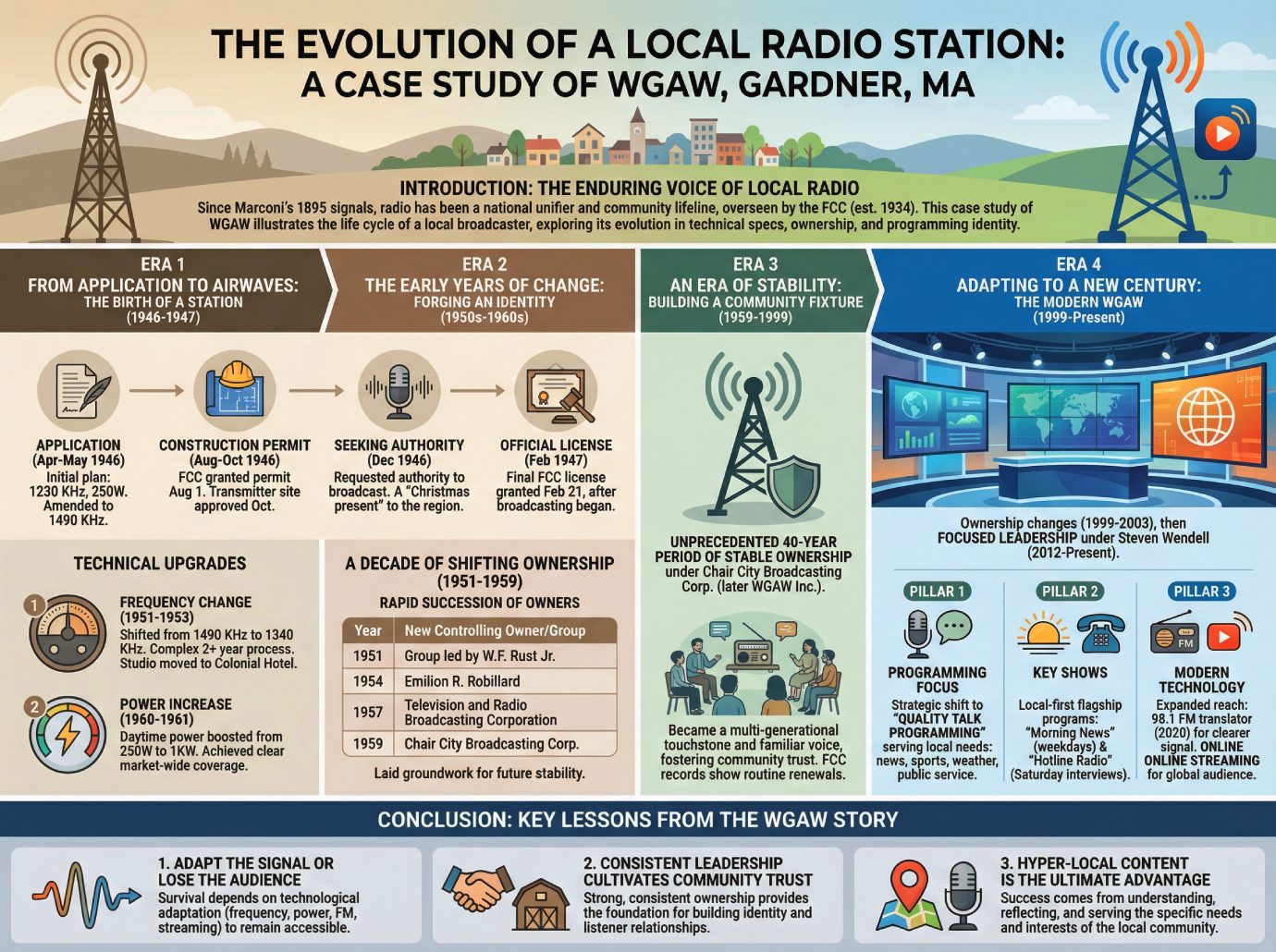
The Evolution of a Local Radio Station: A Case Study of WGAW Gardner, MA
Introduction: The Enduring Voice of Local Radio
Since Guglielmo Marconi first demonstrated groundwave radio signals in 1895, radio has woven itself into the fabric of society. It became a national unifier, famously demonstrated by President Franklin D. Roosevelt’s “fireside chats,” which brought the nation’s leader directly into American living rooms. To manage this powerful new medium, the government formalized its oversight by creating the Federal Communications Commission (FCC) in 1934, the very body that would authorize WGAW’s existence a decade later. Local radio stations, in particular, serve as the lifeblood of information and identity for the towns they serve.
This case study uses the history of a single station—WGAW in Gardner, Massachusetts—to illustrate the typical life cycle of a local broadcaster. By examining its journey from a simple application in 1946 to a multi-platform voice in the 21st century, we can explore how these vital community assets are born, how they evolve, and how they must constantly adapt to survive. We will examine this evolution across three key areas: technical specifications, ownership, and programming identity.
——————————————————————————–
1. From Application to Airwaves: The Birth of a Station (1946-1947)
The creation of a new radio station is not a simple act; it is a meticulous process of federal approval, technical planning, and licensing. The story of WGAW’s founding (originally under the call sign WHOB) provides a clear blueprint for how a station gets on the air.
The station’s journey from concept to broadcast involved four critical steps, overseen by the Federal Communications Commission (FCC):
1. Application (April-May 1946): The process began on April 9, 1946, with an application to broadcast at 1230 KHz with a proposed power of 250 watts. This initial plan was quickly amended just over a month later to a new frequency of 1490 KHz.
2. Construction Permit (August-October 1946): The FCC granted a permit to build the station on August 1, 1946. This is the official green light for construction, and by October, the permanent transmitter site on Green Street in Gardner was officially approved.
3. Seeking Authority (December 1946): Just before Christmas, the founders sought authority to begin broadcasting based on the completed construction. The arrival of a new local media voice was a true “Christmas present this was to the region,” promising a powerful means of community communication.
4. Official License (February 1947): The final FCC license to operate was granted on February 21, 1947. In a common but important nuance of broadcast history, this final approval came several months after the station had already begun broadcasting under the authority of its construction permit.
With the station officially licensed and on the air, the next phase of its life would be one of constant change and refinement as it worked to establish itself.
——————————————————————————–
2. The Early Years of Change: Forging an Identity (1950s-1960s)
The first two decades of operation were a period of significant technical and structural adjustment. Like many young stations, WHOB (soon to be WGAW) spent this time fine-tuning its operations to better serve its market and solidify its technical footprint.
Two major technical upgrades defined this era, each designed to improve the station’s reach and signal quality:
• Frequency Change (1951-1953): The station undertook a complex process to shift its broadcast frequency from 1490 KHz to its current position at 1340 KHz. The two-plus-year timeline—from the application in January 1951 to the final license grant in November 1953—vividly illustrates the bureaucratic and technical challenges of early broadcasting. During this period, the studio also moved to the Colonial Hotel at 4 Pleasant Street.
• Power Increase (1960-1961): The station was granted permission to increase its daytime power from 250 watts to 1 kilowatt (1kw). This fourfold power boost was a significant benchmark for local AM stations of the era, allowing WGAW to achieve clear market-wide coverage and become more commercially viable.
This period was also marked by significant instability in leadership, with control of the station changing hands multiple times in less than a decade.
A Decade of Shifting Ownership (1951-1959)
| Year of Transfer | New Controlling Owner/Group |
|---|---|
| 1951 | Group led by W.F. Rust Jr. |
| 1954 | Emilion R. Robillard |
| 1957 | Television and Radio Broadcasting Corporation |
| 1959 | Chair City Broadcasting Corp. |
This rapid succession of owners in its early years stands in stark contrast to the long-term stability that would soon define the station’s identity.
This era of frequent change laid the groundwork for a long period of consistency that began with the final ownership transfer of the decade in 1959.
——————————————————————————–
3. An Era of Stability: Building a Community Fixture (1959-1999)
In 1959, Chair City Broadcasting Corp. (which would later change its name to WGAW Inc.) took control of the station, ushering in an unprecedented 40-year period of stable ownership. This consistency is the longest in the station’s history and represents a critical phase in its development. FCC records from the 1970s and 1980s reflect this stability, showing primarily routine license renewals without the constant transfers of control that marked the previous decade.
This long-term stability is crucial for a local radio station. Four decades of consistent ownership allowed WGAW to become more than just a media outlet; it became a multi-generational touchstone, a familiar voice woven into the fabric of daily life for listeners in the Gardner area.
This extended period of operational calm set the stage for the rapid technological and programmatic shifts that would arrive at the turn of the 21st century.
——————————————————————————–
4. Adapting to a New Century: The Modern WGAW (1999-Present)
The end of the 20th century brought a return to rapid ownership changes, with the station being sold three times between 1999 and 2003. However, a new era of focused leadership began in 2012 when Steven Wendell acquired the station. Under this new ownership, WGAW has strategically reinvented itself to thrive in the modern media landscape. Its modern identity is built on a strategic adoption of a proven national trend: talk radio. While the national talk radio boom began around 1980, WGAW’s shift decades later demonstrates a calculated move to serve its specific local market with focused, community-centric content.
The modern identity of WGAW is built on three core pillars:
• Programming Focus: The station strategically shifted to “quality talk programming” with a renewed and intense focus on serving its immediate community through “local news, sports, weather, and public service.”
• Key Shows: This local-first identity is exemplified by its flagship programs. The weekday “Morning News” and the popular Saturday interview program “Hotline Radio” both center on local issues, community events, and interviews with regional figures.
• Modern Technology: WGAW has embraced technology to expand its reach. In 2020, it completed its first technical upgrade in six decades by adding a 98.1 FM translator at 250 watts, allowing listeners to hear its programming on the clearer FM band. The station has also successfully implemented online streaming, giving it a global audience with listeners reported from as far away as Europe, Asia, and South America.
Having navigated its foundational years, a long period of stability, and the challenges of the digital age, WGAW’s complete journey offers clear lessons on the life of a local broadcaster.
——————————————————————————–
Conclusion: Key Lessons from the WGAW Story
The 80-year history of WGAW serves as a masterclass in the resilience and adaptability required for a local radio station to thrive in an ever-changing media landscape. From its journey, we can distill three essential lessons about what it takes for a local broadcaster to endure and succeed.
1. Adapt the Signal or Lose the Audience A station’s survival depends on its ability to adapt its technology to reach its audience effectively. WGAW’s history shows a constant progression, from early adjustments in frequency and power to the modern additions of an FM translator and online streaming, ensuring its signal remains accessible and relevant.
2. Consistent Leadership Cultivates Community Trust Leadership has a direct and profound impact on a station’s trajectory. The instability of WGAW’s early years contrasts sharply with the 40-year era of stability that allowed it to become a community fixture. Strong, consistent ownership provides the foundation upon which a station can build its identity and relationship with its listeners.
3. Hyper-Local Content is the Ultimate Advantage Ultimately, a local station’s success is tied to its content. WGAW’s modern revitalization is a direct result of its strategic decision to double down on hyper-local talk programming. This demonstrates the timeless principle that the most successful stations are those that understand, reflect, and serve the specific needs and interests of their local community.
5 Surprising Truths Hidden in the History of WGAW, Gardner MA
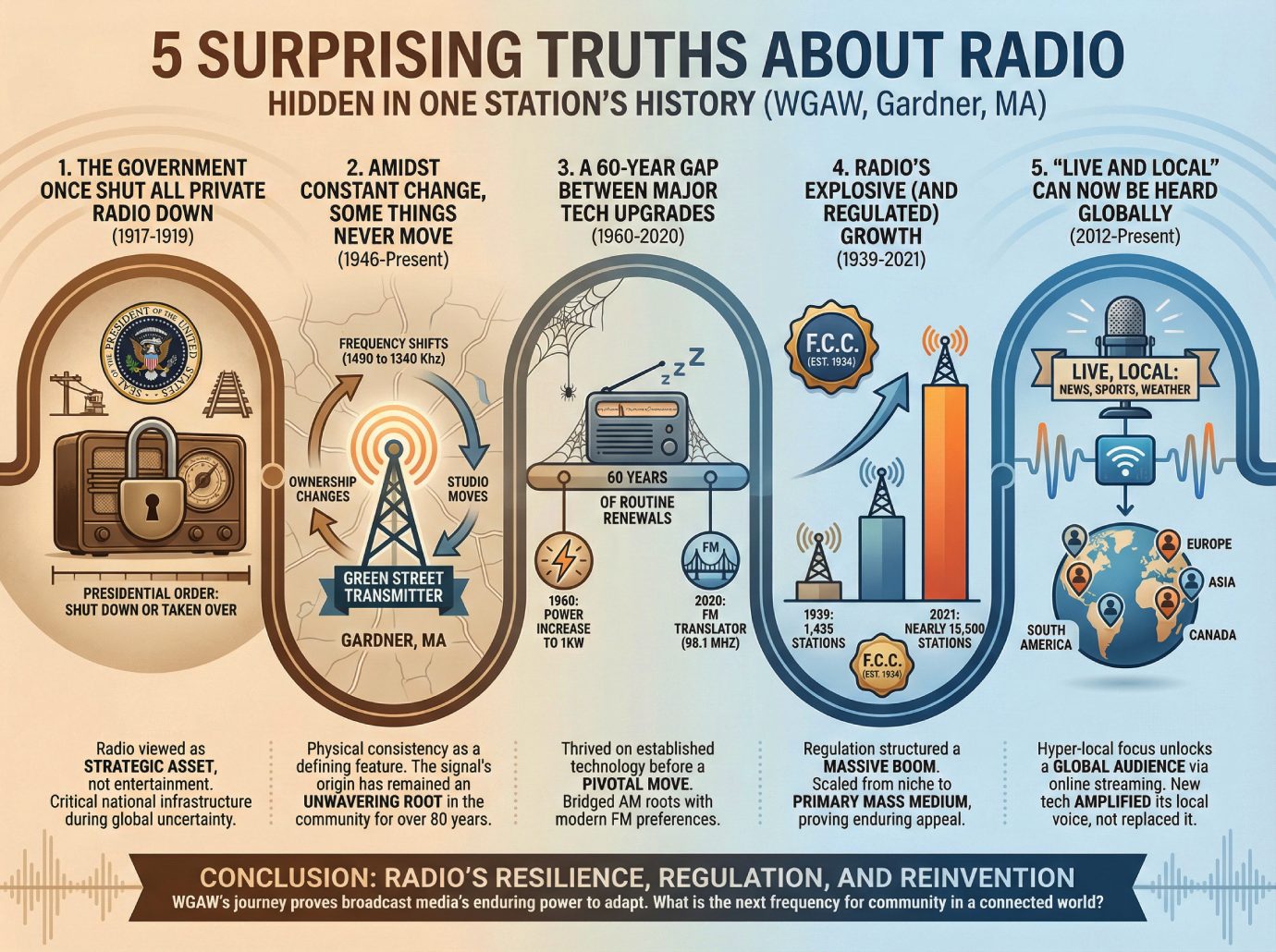
5 Surprising Truths About Radio Hidden in One Station’s History
In an age of on-demand streaming, algorithm-driven playlists, and podcasts for every niche, it’s easy to view traditional AM radio as a relic. But what can we learn by tuning into the history of a single, local station? What secrets about media, technology, and community are hidden in its decades-long signal?
The story of WGAW in Gardner, Massachusetts, reveals a central paradox of legacy media: to survive, it must be both stubbornly consistent and radically adaptable. Its journey is a microcosm of radio’s own surprising resilience, weathering everything from federal takeovers to decades of technological inertia before making the single leap that ensures its future. This article explores the five most impactful takeaways from its long and sturdy history.
1. The Government Once Shut All Private Radio Down
Today, we take media freedom for granted, but one of the most jarring facts from radio’s early days is the extent of government control. In 1917, a presidential order mandated that all private radio stations in the United States be shut down or taken over by the government.
This unprecedented move, which was lifted in 1919, is almost unthinkable in our modern media landscape. This reveals how early radio was perceived not as entertainment, but as a strategic asset on par with railways or the telegraph. Before it was a medium for music and talk shows, it was recognized as a critical piece of national infrastructure, important enough for the government to take complete control during a time of global uncertainty.
2. Amidst Constant Change, Some Things Never Move
The first few decades for the station that would become WGAW, originally founded as WHOB, were a whirlwind of change. It saw multiple ownership groups come and go, changed its broadcast frequency from 1490 Khz to 1340 Khz, and moved its main studio several times. This constant flux was typical for a growing media business finding its footing.
Yet, amidst all this change, one thing remained physically anchored. On October 1, 1946, the station’s construction permit was officially modified to approve its transmitter location on Green Street. It has stood in the same spot ever since. As the station’s own historical account notes, this physical consistency became a defining feature:
In all of its 80 years, amidst all of the ownership changes and programming changes, the station later to be known as WGAW always transmitted from the same Green Street, Gardner MA location.
This single, unchanging physical point represents a deep, unwavering root in its community. While owners, studios, and even frequencies shifted, the station’s signal has always originated from the same place—a constant presence broadcasting home.
3. A 60-Year Gap Between Major Tech Upgrades
While the station’s physical signal was anchored in one place, the technology delivering it was about to enter a long period of dormancy before a dramatic leap forward. In 1960, WGAW received a major boost when it was granted a permit to increase its daytime power to 1kw. After that, however, followed six decades of routine license renewals but no fundamental changes to its broadcast technology.
Then, after sixty years of stability, the station made its next major leap. In 2020, it filed for a permit that would define its modern identity:
…for FM translator W251CQ at 98.1 MHZ… The same programming heard on 1340 AM will now be heard on the FM dial at 98.1 FM.
This sixty-year gap between major upgrades shows how legacy media can thrive on established technology for generations before making a pivotal move to embrace the new. By adding an FM signal, the station bridged the gap between its AM roots and the preferences of modern listeners, ensuring its programming could be heard clearly on any dial.
4. Radio’s Explosive (and Regulated) Growth
WGAW wasn’t born in a vacuum. Its 1946 founding placed it directly in the heart of a national explosion in broadcasting, one of thousands of new voices competing for listeners on a newly regulated frontier. As radio’s popularity surged, the U.S. government stepped in to manage the airwaves, forming the Federal Communications Commission (F.C.C.) in 1934. This regulation didn’t stifle growth; it structured an industry on the verge of a massive boom.
The numbers tell a stunning story of expansion:
By 1939, 1,435 radio stations were authorized to broadcast in the U.S. (nearly 15,500 are in operation in 2021)
This incredible, more-than-tenfold increase over the subsequent decades demonstrates radio’s profound and enduring appeal. It successfully scaled from a niche technology into the primary mass medium for news and entertainment for the better part of a century, proving its power to connect with audiences across the country.
5. “Live and Local” Can Now Be Heard Globally
In 2012, WGAW entered a new era under its current owner, Steven Wendell, with a renewed focus on what makes community radio special: “local news, sports, weather, and public service.” The station dedicated itself to serving its immediate region, operating 24/7 with live, local programming.
But here lies the ultimate paradox of modern media: this intensely local station has achieved a global footprint. By streaming its broadcast online, WGAW has found listeners as far away as Europe, Asia, South America, and Canada. This isn’t just a quaint piece of trivia; it’s a powerful model for the future of niche media, proving that a hyper-local focus can be the key to unlocking a global audience. New technology didn’t replace this old media; it gave its local voice a powerful new reach.
Conclusion: What’s the Next Frequency?
The history of a single AM station in Gardner, Massachusetts, reveals the larger story of radio itself—a story of resilience, regulation, and reinvention. It has survived government shutdowns, navigated decades of technological stasis before making crucial upgrades, and adapted to an internet age that has unexpectedly amplified its local voice to a global audience.
The journey of WGAW is a testament to the enduring power of broadcast media to adapt and thrive. If a local AM and FM station can find a global audience, what does that tell us about the future of community in a connected world?